Jodhpur guide · places
Mehrangarh is a foundation, a five-century complex and a city viewpoint
Do not reduce the fort to 1459 or to the panorama below. Its meaning accumulates through gates, courtyards, rooms, collections, ramparts, institutions and changing views of Jodhpur.
Photograph by Dinesh Valke (opens in a new tab)· CC BY-SA 2.0 (opens in a new tab)
Check before you go
Hours, tickets, schedules, routes and access can change. Use the dated source links below, then confirm time-sensitive details with the responsible operator or venue before you travel.
1459 · five centuries · the city below
Read Mehrangarh in strata, not as one date.
The 1459 foundation opens the story. Five centuries of building, rooms, collections and city relationships keep changing what the visitor sees.
Foundation
Rao Jodha and the ridge
The founding act matters without becoming the date of every visible wall and room.
Historical thresholdAccumulation
Fort and palace fabric
Construction and alteration across roughly five centuries resist a single-period reading.
Source: museum trustMuseum
Period rooms and galleries
The operator currently presents seven period rooms and six galleries as distinct looking scales.
Checked 9 Aug 2026Return view
Ridge, water and habitation
The panorama reconnects the fort to Jodhpur without proving the whole city from above.
Orientation
What this view cannot showThe strata explain kinds of evidence, not a reconstructed construction sequence. They do not show which room is open or measure the visitor route.
Direct answer
Mehrangarh should usually be the main historical block of a first Jodhpur day. Give the museum enough attention to hold together its period rooms, galleries, courtyards, ramparts and the changing relationship with the city below. Pairing it with Jaswant Thada can be coherent, but only after preserving the fort rather than compressing it.
Rao Jodha’s foundation in 1459 is essential; it is not the construction date of everything now seen. The Mehrangarh Museum Trust’s architectural account (opens in a new tab) describes a complex built over roughly five centuries and notes that its chronology is not visually obvious. Read the fort as accumulated fabric.
Current visitor snapshot
Rechecked on 13 August 2026, the official museum visitor page (opens in a new tab) states:
- opening from 09:00 to 17:00, on all days;
- ticket sales closing at 17:00;
- headline admission of ₹200 for domestic visitors and ₹800 for international visitors;
- a ₹50 one-way elevator ticket;
- separate concessions and categories on the operator page.
These are a dated source snapshot, not a promise for another day. Recheck the operator page for rates, concessions, closures, ticket inclusions, events, photography rules and any route change. The published closing time does not establish the latest sensible entry time for seeing the museum properly.
Not one building from 1459
The 1459 foundation act belongs to Rao Jodha and the new capital on the ridge. What a visitor encounters is the result of later construction, alteration, patronage, conflict, display and conservation. A wall, gate, room and museum case can therefore belong to different historical questions even when they appear in one continuous route.
This distinction protects two truths at once: the founding moment matters, and the monument did not freeze in that moment. The full history guide can carry chronology; the visitor guide should help the eye notice accumulation.
What the museum adds
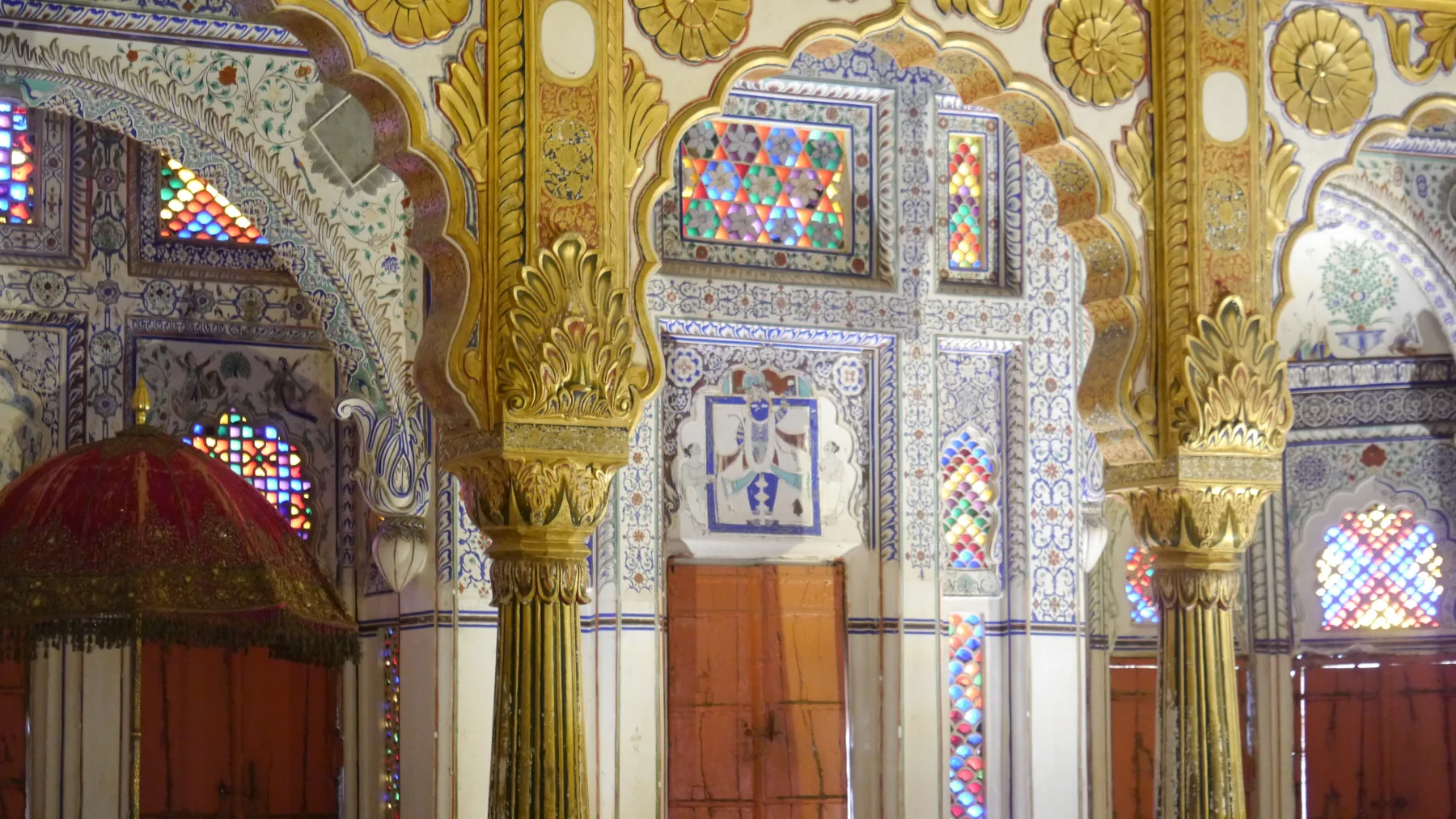
The official visitor page currently presents seven period rooms and six galleries. That count matters because it exposes why the fort cannot be understood from the rampart view alone. Phool Mahal, shown in the page photograph, is one interior threshold; it does not represent every room or prove current access to that room.
Use four reading scales:
- Approach and defence: gates, gradients, walls and the ridge establish controlled movement.
- Court and residence: courtyards and period rooms reveal different uses, patrons and material languages.
- Collection and interpretation: galleries turn objects into institutional narratives that deserve actual looking time.
- Rampart and city: the view reconnects fort, old city, water structures and later urban growth.
Confirm exact open components with the operator for your visit date; the room and gallery count does not guarantee that every space follows the same access pattern each day.
The lift is not an accessibility conclusion
A published one-way elevator is useful operational information. It does not prove that the complete journey—from drop-off and ticket counter through rooms, galleries, toilets, ramparts and exit—is step-free. It also does not establish lift size, queue, assistance, wheelchair circulation, seating frequency, surface condition or a suitable return route.
The honest statement is narrow: an operator-listed one-way lift exists at the checked date; the complete accessible route must still be confirmed directly. Visitors who need specific support should contact the responsible venue before travel.
Choose the route before adding places
The Trust publishes museum, rampart, old-city, Jaswant Thada and nature-trail options (opens in a new tab). Their presence shows that Mehrangarh can open into several different experiences. It does not mean they all belong in one visit.
Add Jaswant Thada when
- the fort has retained a meaningful museum block;
- the group can manage the transfer, exposure and additional walking;
- the memorial’s own ritual and portrait layers will receive attention;
- a protected food, water and rest block still remains.
Do not add another trail when
- the visitor arrived late or is already cutting galleries;
- heat, surfaces or mobility have made the fort demanding;
- the route condition or ticket relationship has not been checked;
- the only reason is to claim more attractions in one day.
Look back at the city carefully
The elevated view is powerful because it makes scale visible: ridge, walls, tanks, roofs, roads and neighbourhoods enter one frame. It is not a licence to claim that everything below is old, blue, public, unchanged or understood from above.
Use the view as an orientation. Continue the old-city and water stories through their own evidence, public routes and present-day conditions.
What to confirm before you go
The foundation-versus-accumulation argument and dated operator information are sourced. Reconfirm realistic dwell time, queue patterns, open galleries, public drop-off, surfaces, steps, lift continuity, toilets, seating, photography protocol and optional trails for the visit date. Use this page to set priorities; use the responsible venue for current operating and individual access needs.
Sources behind this guide
Follow the sources—and know when to check again.
Official and institutional pages are linked with the date they were checked. They can establish a published fact, but not today's queue, route, access or conditions on the ground.
Source links
Official operator
Mehrangarh Museum visitor information (opens in a new tab)
Mehrangarh Museum Trust
Checked 13 Aug 2026· Current at last check
What this source does not tell you
- Hours, prices, concessions, closures, and access rules can change after the checked date
- The page does not prove queue time, visit duration, accessibility experience, or travel time
Official operator
Mehrangarh history (opens in a new tab)
Mehrangarh Museum Trust
Checked 9 Aug 2026· Current at last check
What this source does not tell you
- An operator history is not an exhaustive independent historiography
- Bardic, devotional, legendary, and commemorative layers require explicit attribution rather than presentation as settled fact
Official operator
Mehrangarh architecture (opens in a new tab)
Mehrangarh Museum Trust
Checked 9 Aug 2026· Current at last check
What this source does not tell you
- The overview does not date or attribute every visible architectural element
- It does not establish current room access, conservation condition, visitor route, or photography rules
Official operator
Mehrangarh Museum trails (opens in a new tab)
Mehrangarh Museum Trust
Checked 13 Aug 2026· Current at last check
What this source does not tell you
- A published trail description does not prove current route condition, duration, gradient, shade, universal accessibility, water level, water quality, present enclosure or open public access
- Trail availability and ticket relationships require direct rechecking for the visitor's date
Government source
Jodhpur destination overview (opens in a new tab)
Department of Tourism, Government of Rajasthan
Checked 13 Aug 2026· Current at last check
What this source does not tell you
- Destination copy is not a substitute for venue-specific hours, prices, access, or current on-ground conditions
- Promotional wording does not independently establish current access or visitor conditions
- Its short reach section does not prove today's routes, operators, schedules, fares, terminal, road time, or last-mile availability
What this guide does not promise
- A guaranteed visit duration, queue time, open-gallery list, or universal accessibility claim
- A complete military, political, architectural, conservation, or collection history of Mehrangarh
Names in this guide
Follow the exact term.
Open the city index for alternate names, clear boundaries, connected subjects and the wider Jodhpur context behind this guide.