Jodhpur guide · places
At Umaid Bhawan, plan for the public museum—not the whole palace
The building holds different present-day worlds. Museum access, hotel use and a private royal residence must remain distinct in the language, map, photography and expectations of a visit.
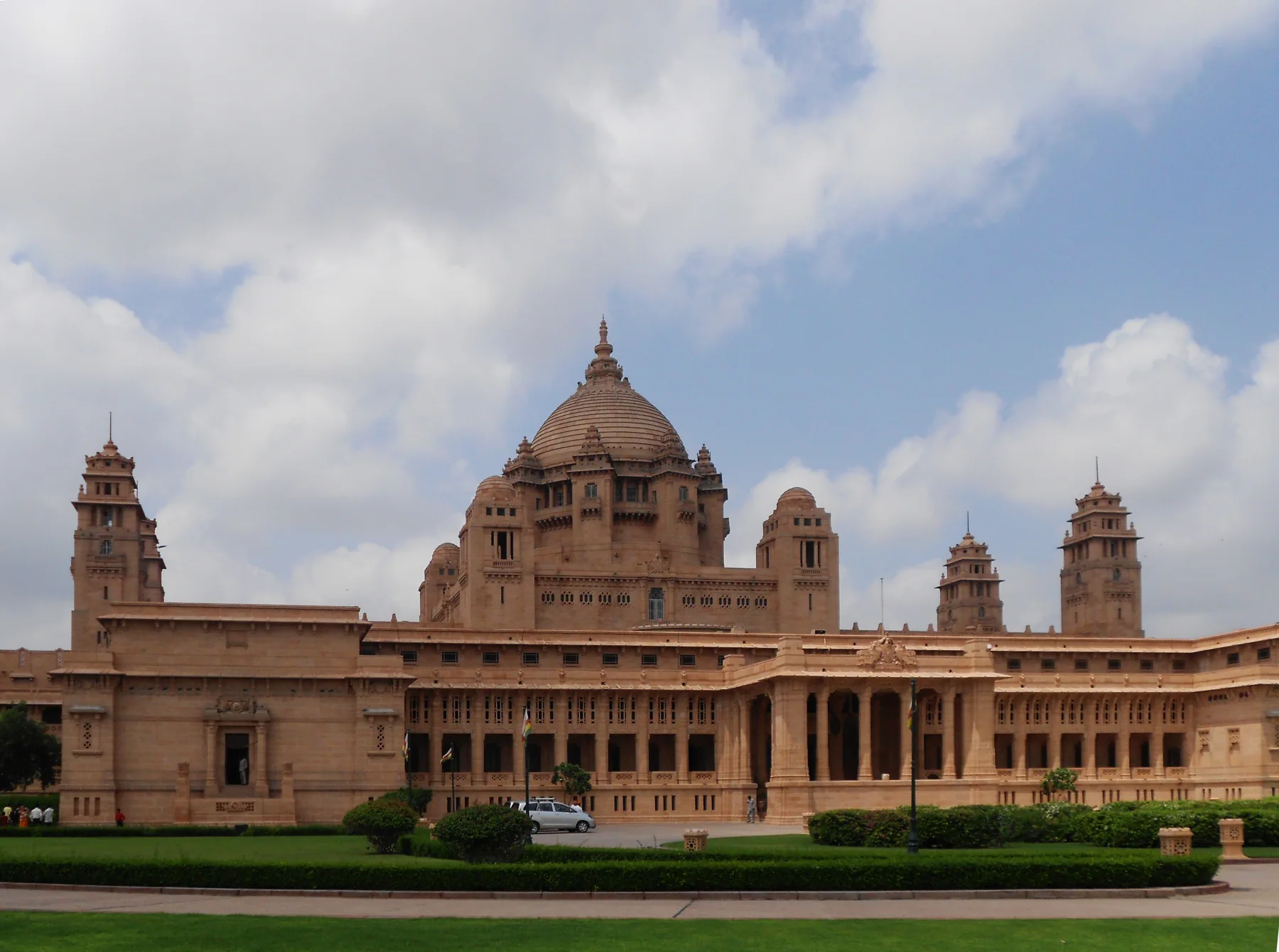
Photograph by Yann Forget (opens in a new tab)· CC BY-SA 4.0 (opens in a new tab)
Check before you go
Hours, tickets, schedules, routes and access can change. Use the dated source links below, then confirm time-sensitive details with the responsible operator or venue before you travel.
Public · booked · private
One exterior. Three present-day boundaries.
The whole building can enter the photograph while only one confirmed layer belongs to the ordinary museum visitor's plan.
Visitor plan
Museum
Confirm the ordinary entrance, ticket and open displays with the responsible museum operator.
Public thresholdCommercial use
Taj hotel
Hotel spaces follow guest, reservation and operator conditions—not museum admission.
Separate permissionResidence
Royal home
Visual proximity creates no visitor entitlement to residential interiors or grounds.
No public assumption
What this view cannot showThis is a use-and-permission model, not a security map. It reveals no private circulation and grants no access beyond current operator instructions.
Direct answer
For ordinary sightseeing, plan Umaid Bhawan Palace Museum—not “the whole palace.” The Ministry of Tourism’s visitor overview (opens in a new tab) presents a public museum component. The Taj operator (opens in a new tab) describes a hotel within the complex and identifies another part as the royal family’s residence.
These sources support a clear boundary: museum access is public-visitor information; hotel access follows commercial guest or reservation conditions; residence access is private. No photograph, map animation or enthusiastic phrase should blur them.
The three present-day boundaries
| Palace use | What this guide may say | What it must not imply |
|---|---|---|
| Public museum | A visitor can plan for the confirmed public entrance, ticket and open displays | Access to every palace room, ceremonial area, garden or collection |
| Taj hotel | A commercial hotel operates within the complex | That museum admission includes hotel spaces, dining, tours or guest facilities |
| Private residence | Part of the palace remains a royal residence | Public entitlement to residential grounds, interiors, photography or personal access |
This is not a ranking among uses. Each area has a different operator, purpose, permission and access rule.
Current visitor snapshot
Checked on 9 August 2026, the national tourism portal publishes 09:00–17:00 visitor hours for Umaid Bhawan. It also describes museum artefacts, memorabilia and a vintage-car display.
That government overview is useful but incomplete for a timed plan. It does not precisely establish the current public entrance, ticket categories, open galleries, whether the car display is operating, photography rules, drop-off, toilets, closures, or the physical route. Those details need confirmation from the responsible museum operator and an ordinary public visit.
Until that confirmation exists, this guide deliberately does not invent a ticket price or promise a particular display.
Why this place changes the Jodhpur story
Mehrangarh begins with a fifteenth-century foundation and accumulated fort-palace fabric. Umaid Bhawan opens a very different question: how a major twentieth-century palace complex functions now as museum, hospitality property and residence.
That contrast is the reason to include it. The visitor does not need to pretend the two palaces are equivalent attractions. They belong to different eras, urban relationships, institutional uses and access rules.
A complete historical interpretation needs specialist sources beyond tourism copy. This page stays focused on the visitor decision and the present access boundary.
What to look for in the museum layer
Use the official overview as a set of questions, not a guaranteed inventory:
- Which artefacts and memorabilia are actually displayed on the visit date?
- Does interpretation explain the palace’s twentieth-century context, construction and present uses clearly?
- Is the vintage-car component open, separately routed or separately ticketed?
- Which areas are public photography spaces, and which are not?
- Where does the museum route end before hotel or residential space begins?
Use only what an ordinary visitor can observe or the responsible operator confirms. Do not fill gaps with hotel imagery or assumptions about the complete palace.
Decide whether it belongs in the day
Choose the museum as a second-day layer when the visitor wants architecture across eras, institutional history, or a lower-density contrast to the fort–old-city axis. Do not add it to the first day merely because the name “palace” appears on the same attraction list.
Confirm the transfer, entrance and likely dwell burden before fixing the day. If the museum route is short, that is not permission to add every distant site; it may be room for lunch, rest, a carefully chosen market layer, or a slower city afternoon.
Public access is also a conduct rule
Follow the signed public route. Do not treat doors, drives, lawns or people visible from public areas as implicit invitations. Ask before close photography where staff, guests or residents may appear. A private boundary does not need spectacle to deserve respect.
Hotel information belongs in the hotel operator’s own booking context and should never be mistaken for museum access.
What to confirm before you go
The three-use distinction and government tourism information are sourced. Before visiting, confirm the responsible museum contact, exact public entrance, current ticket, open displays, vintage-car access, drop-off, toilets, route, photography protocol and any assistance needed. The boundary is clear; day-of-visit operations still belong to the responsible venue.
Sources behind this guide
Follow the sources—and know when to check again.
Official and institutional pages are linked with the date they were checked. They can establish a published fact, but not today's queue, route, access or conditions on the ground.
Source links
Government source
Umaid Bhawan Palace visitor overview (opens in a new tab)
Ministry of Tourism, Government of India
Checked 9 Aug 2026· Current at last check
What this source does not tell you
- The page does not precisely map the museum entrance, ticket, drop-off, hotel boundary, or private-residence boundary
- Published hours and displays need venue-level confirmation before use in a timed itinerary
Official operator
Umaid Bhawan Palace hotel overview (opens in a new tab)
Taj Hotels
Checked 9 Aug 2026· Current at last check
What this source does not tell you
- The hotel page is commercial copy and is not the operating source for public museum entry
- It does not grant general visitor access to hotel or residential areas
Government source
Jodhpur destination overview (opens in a new tab)
Department of Tourism, Government of Rajasthan
Checked 13 Aug 2026· Current at last check
What this source does not tell you
- Destination copy is not a substitute for venue-specific hours, prices, access, or current on-ground conditions
- Promotional wording does not independently establish current access or visitor conditions
- Its short reach section does not prove today's routes, operators, schedules, fares, terminal, road time, or last-mile availability
What this guide does not promise
- Hotel-room, restaurant, event, wedding, or private-residence access and booking advice
- A guaranteed list of open displays, ticket price, route, or universal accessibility claim
Names in this guide
Follow the exact term.
Open the city index for alternate names, clear boundaries, connected subjects and the wider Jodhpur context behind this guide.